Celebrate 2026 & Ramadan with 15% Off AI Marketing Automation


The $250 Million Leaky Bucket: How a Frontline Perspective & an MBA Mindset Fixed a Broken Service Model
A business case study on how a $250M diagnostics retailer (Roche & Hitachi partner) stopped customer churn by shifting from centralized repairs to agile, on-site service. Learn how applying Maastricht MBA leadership traits and the SERVQUAL model bridged the service gap, and how Retailogy is now automating this responsiveness with Agentic AI for 2026.
MARKETING AUTOMATIONRETAILOGY ECOSYSTEMSAI CUSTOMER SERVICEMARKETING RESEARCHMARKETING OF SERVICESRETAIL MANAGEMENTSTRATEGIC MANAGEMENT & MARKETINGAI SOLUTIONS
Dr. Faisal H. Helwa
2/14/20263 min read

The $250 Million Leaky Bucket: How a Frontline Perspective & an MBA Mindset Fixed a Broken Service Mode
A story of bureaucracy, leadership traits, and bridging the SERVQUAL gaps to regain trust in the high-stakes diagnostics industry.
The view from the front line is often vastly different from the view from the boardroom.
More decade ago, I found myself navigating two demanding worlds simultaneously. During the day, I was a medical sales representative serving on the front lines of a $250 million annual revenue diagnostics retailer—a powerhouse in strategic alliance with industry titans like Roche, Johnson & Johnson, and Hitachi. By night, I was immersing myself in advanced marketing frameworks as an MBA candidate at the Maastricht School of Management (MSM) in the Netherlands.
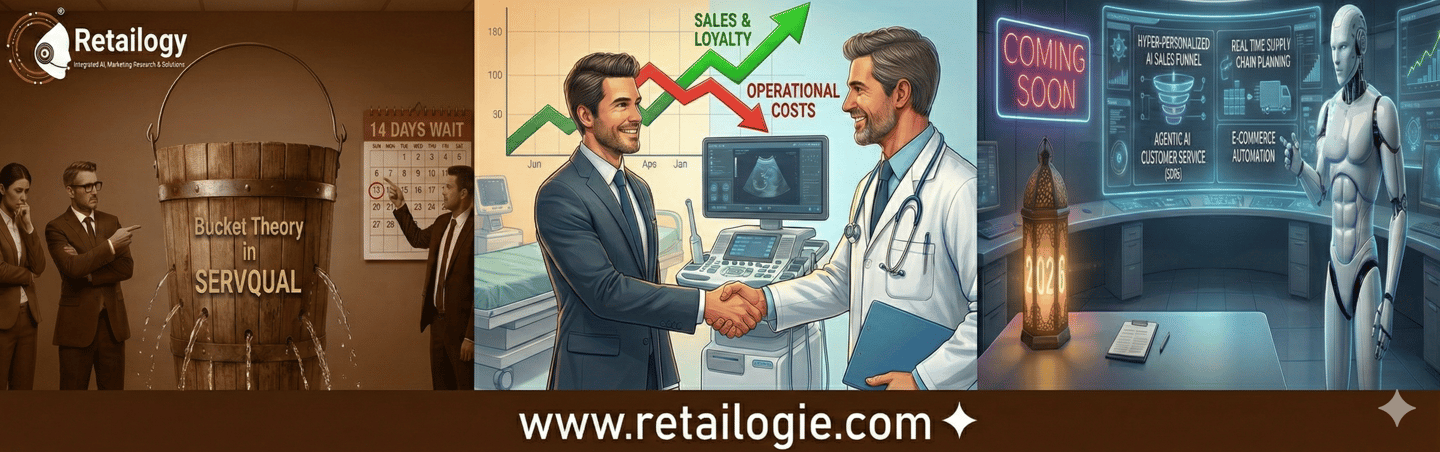
On paper, our company was an untouchable giant, reliant on a "well-established scheme of success" that everyone took for granted. But at the customer touchpoints, I saw a different reality. We were bleeding customers or leaking them according to bucket theory from Marketing of Services prespective "SERVQUAL Model" to their trust, and the giant was beginning to stagger.
The Diagnostics Dilemma: Bureaucracy vs. Empathy
Our customers were highly connected university staff, physiologists, and Key Opinion Leaders (KOLs) who relied on our sophisticated equipment for critical work. When that equipment went down, their operations stopped.
Our corporate protocol for these crises was rigid and centralized. We insisted the customer ship the middle sized to small size, complex equipment back to our headquarters’ service center. Once there, it would sit for 14 days or more, waiting in a queue behind demand from various other business units, all fighting for limited centralized human resources.
While we forced customers to wait, smaller, agile service providers were swooping in. They weren't huge, but they were responsive. Despite of their product quality, they have shown empathy. They visited where the customer's equipment was located and performed the needed repairs immediately.
As a frontline employee, I recognized the symptoms immediately. In marketing terms, our "service quality defects" were creating gaping holes in the brand’s "Bucket Theory." We were pouring sales effort in at the top, but our most valuable customers—those highly connected KOLs—were falling out of the bottom. Worse, their negative Word-of-Mouth was turning them into negative advocates against us.
Maastricht Meets Reality: Bridging the Gaps
My MBA studies at MSM emphasized that frontline employees are often the greatest source of information regarding where organizations need to be more responsive. I knew our company was bureaucratic and resistant to change, suffering from organizational inertia.
I realized that to save the business, I had to apply leadership traits to overcome that bureaucracy. The solution wasn't to work harder; it was to restructure how we worked.
Using the lens of the SERVQUAL model (focusing on Reliability, Assurance, Tangibles, Empathy, and Responsiveness), I spotted an unconventional opportunity. I had a brilliant colleague who was burning out in the high-pressure sales role. Yet, he possessed "ancient relationships" with key decision-makers and had a natural tendency to talk technically about the products.
I championed a bold move: shifting him out of sales and into a newly conceived, decentralized after-sales service role.
Decentralization: A Victory Over Resistance
We didn't just move a person; we redefined the service design to bridge the critical "Service Gaps."
By equipping this colleague with the necessary training and tools to carry out repairs at the site of equipment operation, we immediately addressed Gap 3 (The Service Delivery Gap). We utilized the "12 HR wheel elements" to ensure he was supported in this new, less stressful, yet highly impactful role.
The shift allowed us to meet customers according to their own service-driven standards:
Responsiveness & Tangibles: The service was immediate and visible on-site.
Reliability & Assurance: The technician was a trusted, familiar face with deep technical knowledge at the request.
Empathy: We showed we valued their time by going to them, rather than making them come to us.
The Outcome
The results were astonishing and immediate. The negative Word-of-Mouth ceased as KOLs felt heard and valued. Customers returned to the fold, approving of the restored product and service quality.
This pivot was instantly reflected in recovering sales figures. Perhaps most surprisingly to the finance department, our total operational costs either fixed or variable decreased because we eliminated the expensiveness of reacquiring the lost customers, acquiring new customers, and inventory turnover rates increased. Surprisingly, in an income statement net profit resultant, one dollar decrease in costs equals 100 increased in sales but easier to achieve and can be executed on spot
The success was so undeniable that I was able to generalize these "Decentralized Service Strategies" to other business units within the company. It was a significant victory in the science of change management—overcoming the "hyper-resistance syndrome" typical in large organizations—and proving that sometimes, the most strategic insights come directly from the front lines.