SUMMER DEAL 15% Off AI Marketing Automation



The End of Static Pricing: 4 AI Strategies to Maximize Retail Profitability.
Discover how transitioning from static pricing to AI-powered adaptive commerce can unlock unprecedented profitability for your retail business. This post breaks down four essential machine learning strategies, including dynamic competitor matching and predictive bundling. Learn how these advanced models not only protect your profit margins but also significantly accelerate your inventory turnover. Read the full guide to see how Retailogy seamlessly integrates these transformative pricing engines into your existing systems.
INVENTORY MANAGEMENTSTRATEGIC MANAGEMENT & MARKETINGMOBILE MARKETINGAI SOLUTIONSDIGITAL MARKETINGRETAIL MANAGEMENTMARKETING AUTOMATION
Dr. F. H. Helwa
4/29/20263 min read

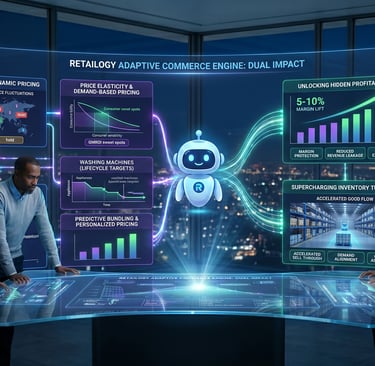
The End of Static Pricing: 4 AI Strategies to Maximize Retail Profitability
Retail is moving rapidly from static pricing models into an era of adaptive commerce. Today, relying on outdated cost-plus strategies or manual competitor matching means leaving significant money on the table—especially in high-ticket retail environments.
The market moves fast. Supply chains fluctuate, competitor inventory drops, and consumer demand shifts by the hour. To stay ahead, forward-thinking retailers are turning to AI engines that continuously adapt to these variables.
Here is a breakdown of the four primary AI-powered pricing strategies we implement at Retailogy, and how they directly impact your bottom line.
1. Algorithmic Dynamic Pricing
Manual competitor checks are a thing of the past. Algorithmic Dynamic Pricing uses AI engines to continuously scrape and analyze competitor pricing, market demand, and external signals, allowing you to adjust prices in real-time.
How it works in practice: Instead of simply matching a competitor’s discount, the AI operates within your pre-set margin floors. For example, if a major competitor suddenly runs out of stock on a highly sought-after 65-inch OLED TV, the AI immediately detects the market shortage. It then automatically raises your price, allowing you to capture a higher margin while you hold the exclusive active supply.
2. Price Elasticity & Demand-Based Pricing
Not all products react the same way to a discount. Machine learning models analyze vast amounts of your historical sales data to map exactly how sensitive your customers are to price changes for specific SKUs.
How it works in practice: The AI pinpoints the exact price point that maximizes your Gross Margin Return on Investment (GMROI). For instance, it might predict that dropping the price of a mid-range air conditioner by 5% right before summer will increase sales volume by 20%. However, dropping it by 10% might only increase volume by 22%. The AI recognizes that the extra 5% discount is an unnecessary margin sacrifice and holds the price at the optimal sweet spot.
3. Markdown Optimization (Lifecycle Pricing)
For products with distinct lifecycles—like last year's home appliances or seasonal electronics—holding costs will eventually outweigh the product's value.
How it works in practice: Blanket 20% store-wide discounts destroy profitability. Instead, AI analyzes the individual sell-through rate of specific items. When it’s time to phase out older washing machine models to make room for new inventory, the AI applies gradual, location-specific markdowns. It lowers the price just enough to clear the stock by your target date, preserving as much margin as mathematically possible.
4. Predictive Bundling & Personalized Pricing
Modern retail isn't just about what you price, but who you price it for. By analyzing customer behavior, purchase history, and segmentation data, AI creates highly dynamic, personalized offers.
How it works in practice: The AI identifies items that are frequently bought together and crafts targeted bundle discounts. If a shopper adds a high-end espresso machine to their digital cart, the system instantly generates a time-sensitive, personalized discount on compatible water filters and premium coffee beans. This provides immediate value to the customer while significantly boosting your Average Order Value (AOV).
The Dual Impact: Profitability and Inventory
Integrating these advanced models transforms pricing from a passive administrative task into an active growth lever.
Unlocking Hidden Profitability:
Margin Protection: AI prevents the dreaded "race to the bottom." It knows exactly when a price drop is necessary to win a sale, and when your brand equity and current demand can sustain a premium price—often increasing overall profit margins by 5% to 10%.
Reduced Revenue Leakage: Automated execution eliminates human error and the costly delays of manual updates, ensuring you never accidentally sell below cost or miss out on a competitor's stockout.
Value Extraction: Targeted promotions capture the maximum willingness-to-pay from different customer segments, eliminating the need for margin-destroying, store-wide sales.
Supercharging Inventory Turnover:
Accelerated Sell-Through: Markdown optimization ensures slow-moving goods leave the warehouse efficiently, freeing up physical space and capital for high-turnover items.
Demand Alignment: By accurately predicting seasonal shifts and price elasticity, pricing acts as a throttle. You can seamlessly dial demand up or down, preventing both costly stockouts of fast-moving items and expensive overstock situations.
Optimized Assortment: Continuous pricing data feeds directly back into your purchasing cycle. You will know exactly which SKUs are highly price-sensitive and which command a premium, allowing for a leaner, faster-moving product selection.
Ready to transition to adaptive commerce?
At Retailogy, our dedicated AI brand character, Retailogy, is ready to help you architect a pricing ecosystem built for the future. We handle the complex algorithmic integrations so you can focus on scaling your business.
Click here to explore Retailogy Horizons AI Sales Suite
Zero noise. Just high-signal AI retail strategies, dropped Monthly.
Phone
hello@retailogie.com
+201111268161
© 2026 All rights reserved.
Address: Lotus Mall,North 90th St., third Floor, New Cairo, Egypt
+226124800