SUMMER DEAL 15% Off AI Marketing Automation



What a Retailogy AI Mobile App Actually Does for Your Revenue — Feature by Feature
Not a brochure. Not a digital flyer. A Retailogy AI mobile app is a revenue engine that runs on your customers' phones 24/7 — here's exactly what it does and why it pays for itself.
Retailogy Strategy Team
7/3/20265 min read
Mobile Is Where Loyalty Is Won or Lost
Over 70% of e-commerce traffic now comes from mobile devices. But traffic is not the same as revenue. Most mobile experiences are optimized for browsing, not buying — slow-loading pages, clunky checkout flows, no push notifications, no personalization. The customer arrives, browses, and leaves. Possibly forever.
A Retailogy AI mobile app changes that equation entirely. It places your brand inside your customer's pocket, learns their behaviour, reaches them at exactly the right moment, and makes purchasing easier than opening a browser tab. Here's precisely how it works — feature by feature.
Feature 1: Native iOS and Android Performance — Not a Hybrid Wrapper
Most "mobile apps" built on budget platforms are hybrid wrappers — websites disguised as apps that run inside a browser shell. They load slowly, feel clunky, and get penalized by App Store algorithms that measure genuine native performance metrics.
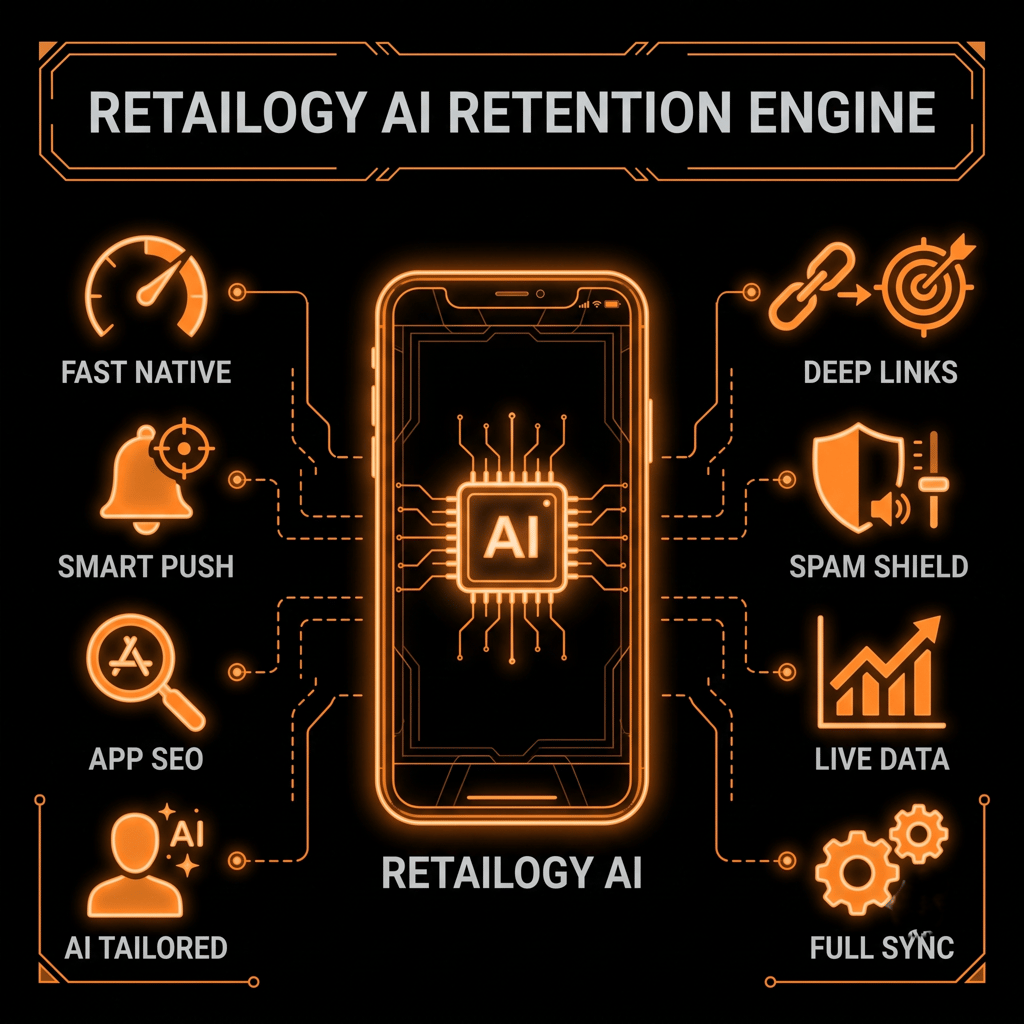
Retailogy builds true native performance on both iOS and Android from a unified codebase — 60 frames per second animations, instant screen transitions, and data loading that feels immediate rather than waiting. This isn't cosmetic. App Store ranking algorithms directly reward native performance metrics, which means better organic visibility, more downloads, and lower cost-per-acquisition.
Feature 2: Behavioural Push Notifications That Convert at 50% Higher Rates
Standard push notifications are broadcast messages — the same offer sent to every subscriber at the same time. They perform poorly because they're irrelevant to most recipients. Retailogy's behavioural push system operates differently:
• Notifications trigger based on real-time user actions, not scheduled time slots
• A customer who viewed a product three times but didn't purchase receives a targeted offer for exactly that product
• A customer who hasn't opened the app in 14 days receives a win-back message with a time-sensitive incentive
• A customer who just completed a purchase receives a cross-sell notification 48 hours later based on their purchase history
Behavioural push notifications achieve engagement rates 50% higher than standard email marketing sequences — because they arrive at the moment of maximum relevance, not the moment that's convenient for your marketing calendar.
Feature 3: App Store Optimization (ASO) That Compounds Monthly
Every month your app is live and well-optimized in the App Store or Google Play, it accumulates organic authority that generates free daily downloads. ASO is the mobile equivalent of SEO — and most brands either ignore it or execute it poorly.
Retailogy's ASO management covers every lever that drives App Store ranking:
• Keyword mapping targeting high-volume, low-competition terms your ideal customers actually search
• Title and subtitle optimization — the highest-weighted ranking fields in both App Store algorithms
• Screenshot design that communicates value in under three seconds — because customers decide in that window
• Review generation flows that request ratings at exactly the right moment — post-successful-action, not randomly
• Update cadence management to signal ongoing platform commitment to App Store crawlers
The compounding effect is significant. A well-executed ASO strategy typically generates 30–65% of total downloads organically within six months — reducing paid acquisition dependency and improving the lifetime value of acquired users by the same margin.
Feature 4: AI-Powered Personalization at the Individual User Level
Generic mobile experiences treat every customer identically. Retailogy's AI layer treats every customer individually — adjusting what they see, what they're offered, and how they're messaged based on their specific behaviour profile.
This means:
• Product recommendations change dynamically based on browsing history and purchase patterns
• Pricing and promotional offers adjust based on each user's demonstrated price sensitivity
• Content and messaging adapt to match each user's engagement patterns — what they click, what they ignore, what they share
• Re-engagement sequences are personalized to reference specific products the user has shown interest in
The business impact of genuine AI personalization versus generic broadcast messaging is measurable: higher average order value, lower cart abandonment rates, and longer customer lifetime — all from the same user base, without increasing acquisition spend.
Feature 5: Deep Linking That Eliminates Navigation Friction
When a push notification or marketing message directs a customer to your app, where they land matters enormously. Sending them to your home screen forces them to navigate to the product or offer they were interested in — and every extra navigation step loses a percentage of them.
Retailogy implements deep linking architecture across all notification and marketing touchpoints — meaning every push notification, every email link, every social media CTA takes the customer directly to the specific product page, checkout screen, or promotional offer, not your app's front door.
This single architectural decision consistently produces measurable improvements in conversion rate because it eliminates the friction between purchase intent and purchase completion.
Feature 6: Frequency Controls That Protect Retention
The fastest way to lose your mobile audience is to over-message them. Push notification fatigue is real — it triggers uninstalls, notification permission revocations, and negative App Store reviews, all of which compound into long-term damage to your app's ranking and reputation.
Retailogy builds strict frequency controls and engagement-based suppression logic into every notification system:
• Users who haven't engaged with recent notifications are automatically suppressed from the next campaign cycle
• Notification volume caps prevent any single user from receiving more than a defined number of messages per week
• Permission request timing is delayed until a user has experienced meaningful value — dramatically improving opt-in rates
The result is a notification audience that stays healthy, engaged, and growing — rather than a list that erodes through uninstalls and opt-outs faster than you acquire new subscribers.
Feature 7: Real-Time Analytics Tied Directly to Revenue
Most mobile analytics tools tell you what happened. Retailogy's event-driven analytics tell you what generated revenue — and what didn't. Every user action inside your app is tracked as an event: screen views, product taps, add-to-cart actions, abandoned sessions, completed purchases, notification opens, and post-purchase behaviour.
These events are connected directly to your revenue dashboard, so you can see exactly which notification campaign drove which purchase, which product page has the highest drop-off rate, and which user segment generates the most lifetime value.
This closes the attribution gap that plagues most mobile marketing — where brands spend on push campaigns and know they ran, but can't prove what they generated. Retailogy's mobile analytics make the connection explicit →
Feature 8: Seamless Integration With the Full Retailogy Ecosystem
A mobile app in isolation is a retention tool. A mobile app connected to Retailogy's full ecosystem is a complete revenue engine. Retailogy's mobile architecture integrates directly with:
• AI Sales Funnel — so abandoned app sessions trigger automated follow-up sequences across WhatsApp, email, and retargeting
• AI Web Marketing Solutions — so customer behaviour data flows between your website and your app, building a unified profile for each customer
• AI Commerce Suite — so pricing, bundling, and promotional strategy is consistent and algorithmically optimized across every channel simultaneously
This means a customer who browses your website, installs your app, abandons a cart, and then receives a WhatsApp follow-up is experiencing one coherent, intelligent journey — not three disconnected tools that don't know about each other.
The Numbers: What This Infrastructure Produces
When Retailogy's mobile features operate together — native performance, behavioural push, ASO, personalization, deep linking, frequency controls, and connected analytics — the cumulative effect on revenue metrics is significant:
• Customer retention rates increase substantially over email-only retention strategies
• Organically acquired app users demonstrate up to 65% higher lifetime value than users acquired through paid channels
• Deep-linked push notifications achieve conversion rates that outperform generic campaign messages by a wide margin
• App Store organic ranking compounds over time — monthly download volume grows without proportional increases in acquisition spend
These aren't hypothetical projections. They're the measurable outcomes of building mobile infrastructure correctly — with native performance, behavioural intelligence, and a connected ecosystem underneath it.
Conclusion: Your Mobile App Should Work Harder Than Your Sales Team
It should know your customers better than they know themselves. It should reach them at the right moment with the right offer — automatically. It should grow its own download base through App Store authority. It should tell you exactly what drove each sale. And it should connect seamlessly with every other part of your revenue infrastructure.
That's not what most mobile apps do. That's what a Retailogy AI mobile app does — by design, from day one, for every client we build for.
Zero noise. Just high-signal AI retail strategies, dropped Monthly.
Phone
hello@retailogie.com
+201111268161
© 2026 All rights reserved.
Address: Lotus Mall,North 90th St., third Floor, New Cairo, Egypt
+226124800