SUMMER DEAL 15% Off AI Marketing Automation



What Great Management Philosophy Teaches Us About AI-Driven Retail Strategy
The best operators fix problems at the source, not the symptom. Discover how the most enduring principles of strategic management map perfectly onto building a retail AI ecosystem that doesn't just perform — it compounds.
Retailogy Strategy Team
7/8/20265 min read
The Situation: Technology Without Wisdom Is Expensive Noise
In the rush to adopt AI tools, most businesses are making the same mistake that organisations made in the early days of digital transformation: they're buying tools, not building systems. They're patching symptoms, not treating causes. And they're measuring activity rather than outcomes.
The most enduring principles of strategic management — principles that built industrial empires and sustained competitive advantages across decades — are not obsolete in the age of AI. They are more relevant now than they have ever been. Because the same discipline, systems thinking, and commitment to structural advantage that separated the great organisations from the merely good ones still determines who wins. The tools are just faster.
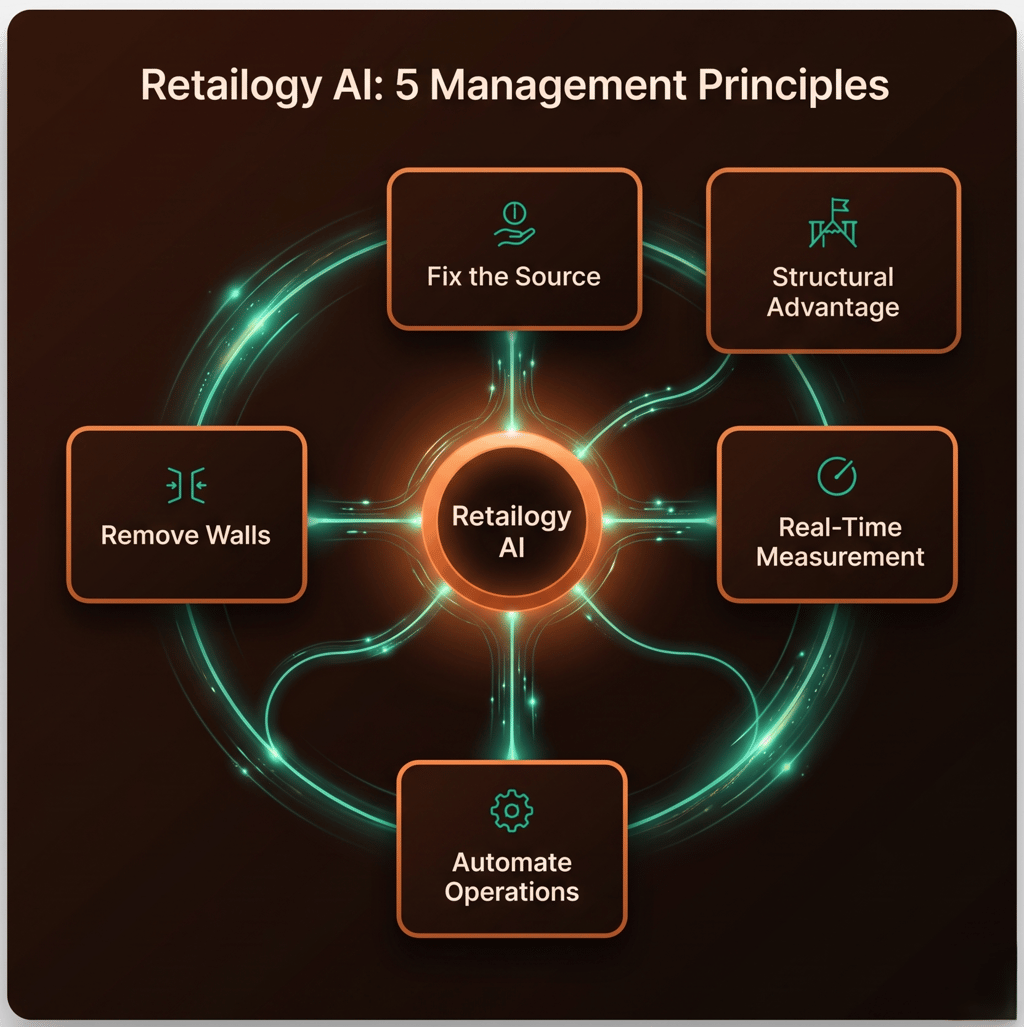
Here are five management principles that the most sophisticated operators apply consistently — and how each one maps directly onto how Retailogy's AI ecosystem is built.
Principle 1: Fix the Problem at the Source, Not the Symptom
One of the most consistent patterns in high-performance management is the discipline to distinguish between symptomatic problems and root causes. The organisation that loses customers after their first purchase and responds by increasing acquisition spend has identified the symptom — declining revenue — and applied a solution that doesn't address the cause: a broken retention infrastructure.
The same logic applies to digital marketing systems. Pouring budget into traffic acquisition when your website has a 70% cart abandonment rate is treating the symptom. The cause is a disconnected funnel with no automated recovery mechanism.
Retailogy's approach starts here — with AI web infrastructure that closes conversion gaps before traffic is scaled, and a Sales Funnel that recovers lost revenue automatically rather than replacing it with new acquisition spend. Fix the source. Then scale.
Principle 2: Remove the Walls Between Your Systems
The concept of the boundaryless organisation — removing the internal barriers that prevent information from flowing freely between departments — was one of the defining management ideas of the late twentieth century. The insight was simple: silos don't just reduce efficiency. They destroy the organisation's ability to respond coherently to what customers actually need.
In digital marketing, the equivalent of departmental silos is disconnected tools. Your website doesn't know what your email platform learned. Your CRM doesn't know what your app's push notifications discovered. Your sales team is working from different data than your marketing team. The result is exactly what it was in siloed organisations: decisions made on incomplete information, customer experiences that feel disjointed, and revenue lost at every handoff point.
Retailogy is architecturally boundaryless — one source of truth where your web marketing, mobile app, sales funnel, and commerce strategy all share the same customer data in real time. Every part of the journey informs every other part. That's not a feature — it's the entire strategic point.
Principle 3: You Cannot Manage What You Do Not Measure
This principle predates AI by decades — but it takes on new dimensions when applied to real-time digital infrastructure. Traditional measurement meant quarterly reviews and monthly reports. By the time the data reached the decision maker, the opportunity had passed or the problem had compounded.
AI-powered measurement operates on a different timescale. Customer behaviour signals — which product pages attract the highest-intent visitors, which notification campaigns produce the most purchases, which pricing points maximise revenue at different demand levels — are available in real time and can trigger automated responses without human latency.
The management principle remains the same. The execution is now instantaneous. Retailogy's analytics architecture connects every customer action to a revenue outcome — so the measurement doesn't just inform decisions. It makes them, faster than any human team could.
Principle 4: Operational Discipline Liberates Strategic Capacity
One of the quieter insights of high-performance management is that the leaders who spend their time on operational firefighting — manually following up leads, managing one-by-one customer communication, chasing abandoned carts by hand — are not just inefficient. They are strategically disabled. Every hour spent on tasks that should be automated is an hour not spent on the decisions that only human judgment can make.
The promise of genuine automation isn't the elimination of human work. It's the elevation of it. When Retailogy's AI Sales Funnel handles cart recovery, lead qualification, WhatsApp follow-up, and meeting scheduling autonomously, the business leader is freed to focus on what no AI can do: building strategic relationships, entering new markets, developing products, and making bets on the future.
Automation done correctly doesn't replace leadership capacity. It creates it.
Principle 5: Structural Advantage Compounds — Price Advantage Erodes
The most durable lesson from studying market leaders across sectors is that the ones who sustain dominance for decades do so not by being cheaper, but by defining the criteria by which quality is judged in their category. They build structural advantages — data moats, distribution depth, brand authority, customer switching costs — that competitors cannot replicate simply by lowering their prices.
In digital retail, structural advantage comes from three compounding sources: positioning clarity that speaks to a specific audience in their language precisely, a customer experience that doesn't invite price comparison because it simply has no equivalent at any price, and a data foundation that makes your decisions sharper with every transaction.
Retailogy's AI Commerce Suite is built to construct exactly this kind of structural advantage — through Ansoff Matrix-guided growth planning, Blue Ocean positioning, and algorithmic pricing that responds to real-time market signals. The goal is not to win this quarter's price war. It's to make price wars irrelevant.
The Decision Point: Why These Principles Matter More Now, Not Less
The emergence of Agentic AI — AI systems that act autonomously on behalf of the business rather than simply responding to prompts — changes the leverage available to disciplined operators dramatically. In the hands of a business with clear positioning, unified data, and a connected infrastructure, agentic AI compounds advantages at a speed no manual operation can match.
In the hands of a business without these foundations, it compounds chaos at the same speed.
The management principles above are not abstractions. They are the prerequisites for AI to work. Get the foundations right — fix the source, remove the silos, measure what matters, automate operations, and build structural advantage — and AI becomes a force multiplier. Skip the foundations, and AI is just another expensive tool that underperforms its promise.
Conclusion: The Framework Is Old. The Speed Is New.
The businesses that will define their categories in the next decade are not necessarily the ones with the largest AI budgets. They are the ones applying the most disciplined thinking to the oldest strategic questions: Where are we losing value we shouldn't be losing? What walls are preventing our data from flowing freely? What should we be measuring that we aren't? What are we doing manually that should be automatic? And where is our competitive advantage genuinely structural rather than temporarily priced?
These are management questions. Retailogy provides the infrastructure to answer them at scale. The combination — strategic clarity and AI execution — is what sustainable market leadership actually looks like in 2026. See how Retailogy's ecosystem applies these principles in practice →
Zero noise. Just high-signal AI retail strategies, dropped Monthly.
Phone
hello@retailogie.com
+201111268161
© 2026 All rights reserved.
Address: Lotus Mall,North 90th St., third Floor, New Cairo, Egypt
+226124800